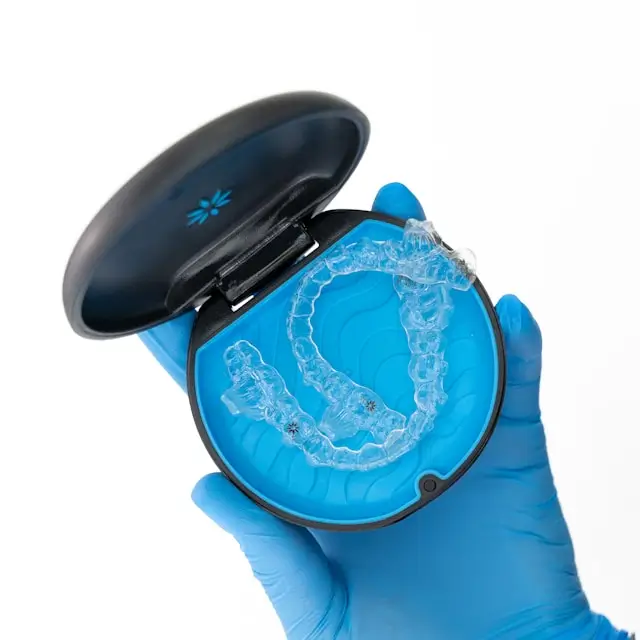
Invisalign isn’t “set and forget”
Clear aligners can be effective, however the research summaries indicate limitations for specific movements and completing details in more complex cases; therefore, regular monitoring is essential.
Plain language for patient perspective: Individuals desire discrete treatment; nonetheless, individuals also desire “no surprises,” and the most significant surprising elements include:
- attachment (perception + maintenance)
- refinement (additional sets of aligners)
- compliance (it is more difficult to comply with 22 hours per day than it appears)
Therefore, let us discuss the “tools” to be used at the onset.
1) Invisalign Attachments: What Are Attachments & Why Will I Need Them?
Attachments are small, tooth colored shapes that are bonded to specific teeth to enable the clear aligner to “grab” and move the tooth in a more predictable manner. Invisalign states that the provider has reviewed the ClinCheck plan and placed the attachments accordingly.
What Patients Should Expect:
- The attachments can cause the clear aligners to appear slightly more visible at close proximity.
- The attachments may initially appear to have a bumpy appearance.
- The attachments may stain if staining beverages are consumed on a frequent basis, without proper oral hygiene (this can vary depending upon individual).
Why This Matters Regarding Results:
Some movements (such as rotation, extrusion, etc.) may not be as predictable without the use of proper attachments.
2) IPR: Enamel Polishing To Prevent Larger Problems
IPR (Interproximal Reduction) is a procedure performed by a clinician to remove a very small amount of enamel between teeth. It can:
- Provide sufficient space
- Some cases, create sufficient space to reduce black triangle formation
- Create tracking space by removing “collision points” that teeth cannot physically pass each other over
Public Concern: “Will You Be Shaving My Teeth Down?”
A Good Explanation: It typically measures in fractions of a millimeter, is planned digitally and is done conservatively—only when it will improve the final outcome.
3) Elastics: Bite Correction Using Hidden Secret
If your goals include bite correction (overbite, underbite tendencies, crossbite), elastics may be suggested. They are used to attach the aligner to provide the desired relationship of jaw to teeth (case dependent).
4) Refinements: Why They Happen & How To Decrease The Chances Of Occurrence
Refinements are additional sets of aligners that are ordered after the initial set of aligners if the teeth did not track properly or if there were additional finishing details that needed to be addressed. Common Reasons For Refinements Include:
- Aligners were not worn consistently enough
- Attachments popped off or wore down
- Biology Variation (Teeth Don’t All Move Equally)
- Complex Movements That Require Staged Approaches
Most dentists indicate in patient education content that the average hours per day for wear time is approximately 20-22 hours/day.
Patient First Framing:
Refinements aren’t “failure”. They are simply the final stage — like tailoring a suit after the initial fitting.
5) Timeline: What Actually Determines The Amount Of Time Needed For Treatment
Rather than promising a universal number of days, explain the true drivers:
A) complexity of movement
- Mild crowding/spacing → fewer aligners
- Bite correction + rotations + torque → more aligners
research summaries suggest that aligners can be effective for mild-to-moderate cases, however complex finishing details can make treatment more difficult.
B) wear consistency
the plan assumes that the aligners will be worn consistently. If the patient does not wear the aligners for a significant portion of each day, the teeth may fall behind schedule and result in refinements.
C) monitoring + mid-course corrections
if the attachments are replaced quickly and the fit is monitored, many small tracking issues can often be prevented from becoming major delays.
6) Real World Bite Considerations (Why Expertise Matters):
In one of dr. Cheng’s published cases, unplanned molar intrusion caused by the use of aligners contributed to a posterior open bite and was corrected using a fixed partial appliance with tads.
See our Invisalign treatment results
- Aligners: discreet, removable, easier hygiene; effective for many cases
- Braces: often stronger control for complex finishing/torque/occlusal contacts (depends on case and provider)
TOP FREQUENTLY ASKED QUESTIONS