
Dental implant care in Vancouver
Explore the clinic’s implant assessment, treatment planning and consultation pathway.
Dental insights
How gum health, jaw clenching and a new HRV hypothesis relate to long-term implant care, and what remains untested.
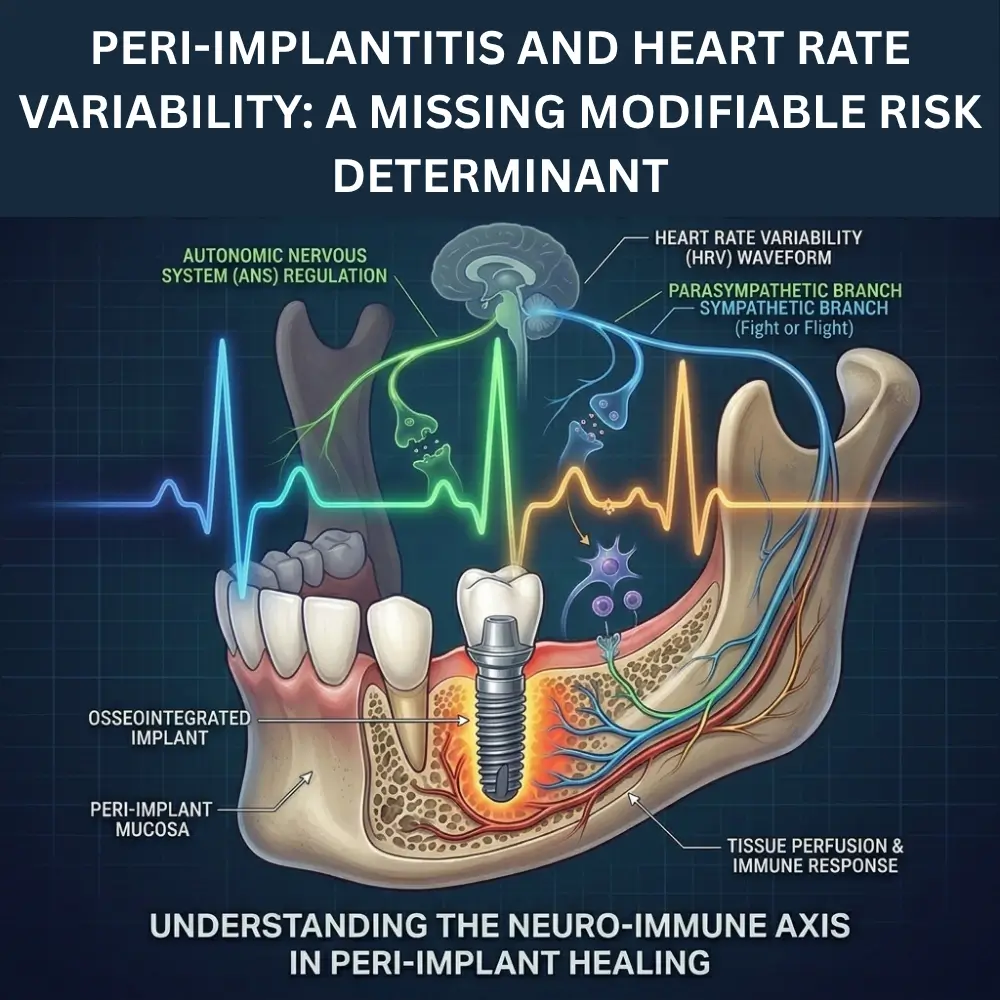
Dental implants can function for many years, but research estimates that peri-implantitis affects around one in five implant patients. This involves inflammation and loss of supporting bone around an implant. A new paper by Westcoast Smile’s Dr. David Cheng explores whether the body’s regulation of inflammation, together with clenching and grinding, may help explain differences between patients. It presents a hypothesis that still needs testing.
Research context: Dr. David Cheng’s hypothesis and theory article, published in Frontiers in Dental Medicine on 20 October 2026.
A dental implant is a small post placed in the jaw that supports a crown, bridge or other replacement tooth. After it becomes stable in the bone, it can support chewing for many years. Peri-implantitis involves inflammation around the implant together with progressive loss of supporting bone.
It is not rare. A large 2025 review of 102 studies and more than 13,000 patients puts it at roughly 21% of implant patients, with about 22% affected over twenty years. Most implants do well. But a meaningful minority run into this problem, and dentists still cannot reliably predict who will.
It also helps to know what peri-implantitis is not. A little bone settling around a new implant in the first months is usually normal. The body is building a seal of gum and tissue around the implant, and some bone remodels to make room for it. Your dentist tracks this on x-rays so that normal healing is not confused with the start of a problem.
Several factors are linked with higher odds of peri-implantitis, mostly in the range of two to four times. These are risk indicators, not guarantees: plenty of people with them never develop the problem.
| Factor | What studies found | What you can do |
|---|---|---|
| History of gum disease | About 3 times the odds; about 4 times if the disease is active | Treat gum disease first and keep up periodontal care |
| Little firm, attached gum around the implant | About 2.8 times the odds | Ask for the gum to be checked at planning and at reviews |
| Skipping professional maintenance | About 2.4 times the incidence in a 5-year study | Keep your hygiene and implant review visits |
| Diabetes | About 2.3 times the odds | Keep blood sugar well controlled with your doctor |
| Smoking | A modest risk indicator; about double the odds of implant failure in one analysis | Cut down or quit, and ask us for support |
| Depression or antidepressant use | Listed as a risk indicator in the 2025 expert consensus | Share your medical history and current medications with your dentist |
These associations do not predict an individual patient’s outcome. Daily plaque control, smoking cessation support and professional maintenance remain important parts of implant care. The new paper asks whether additional host-response factors may help explain differences that the usual risk indicators do not fully capture.
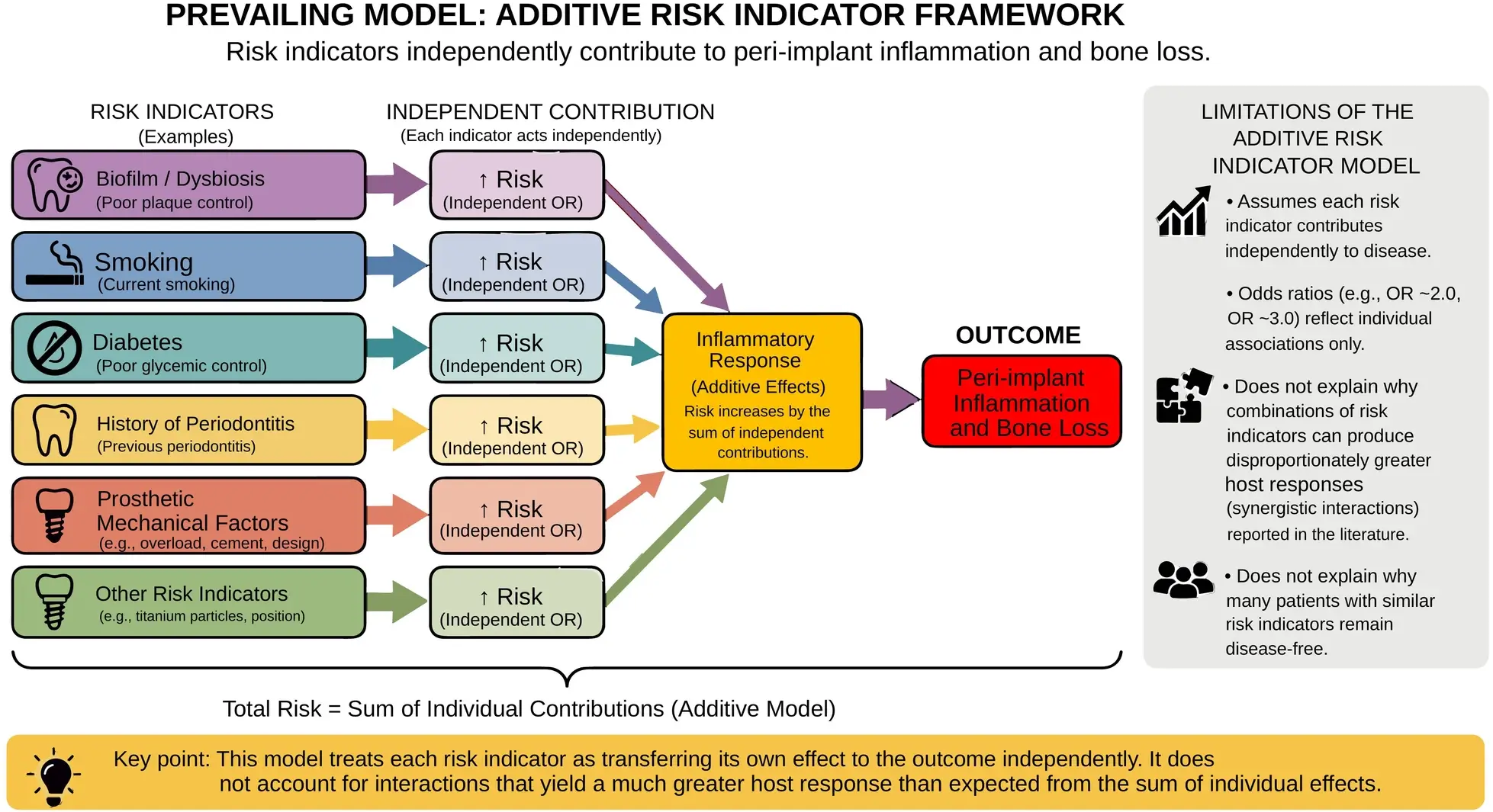
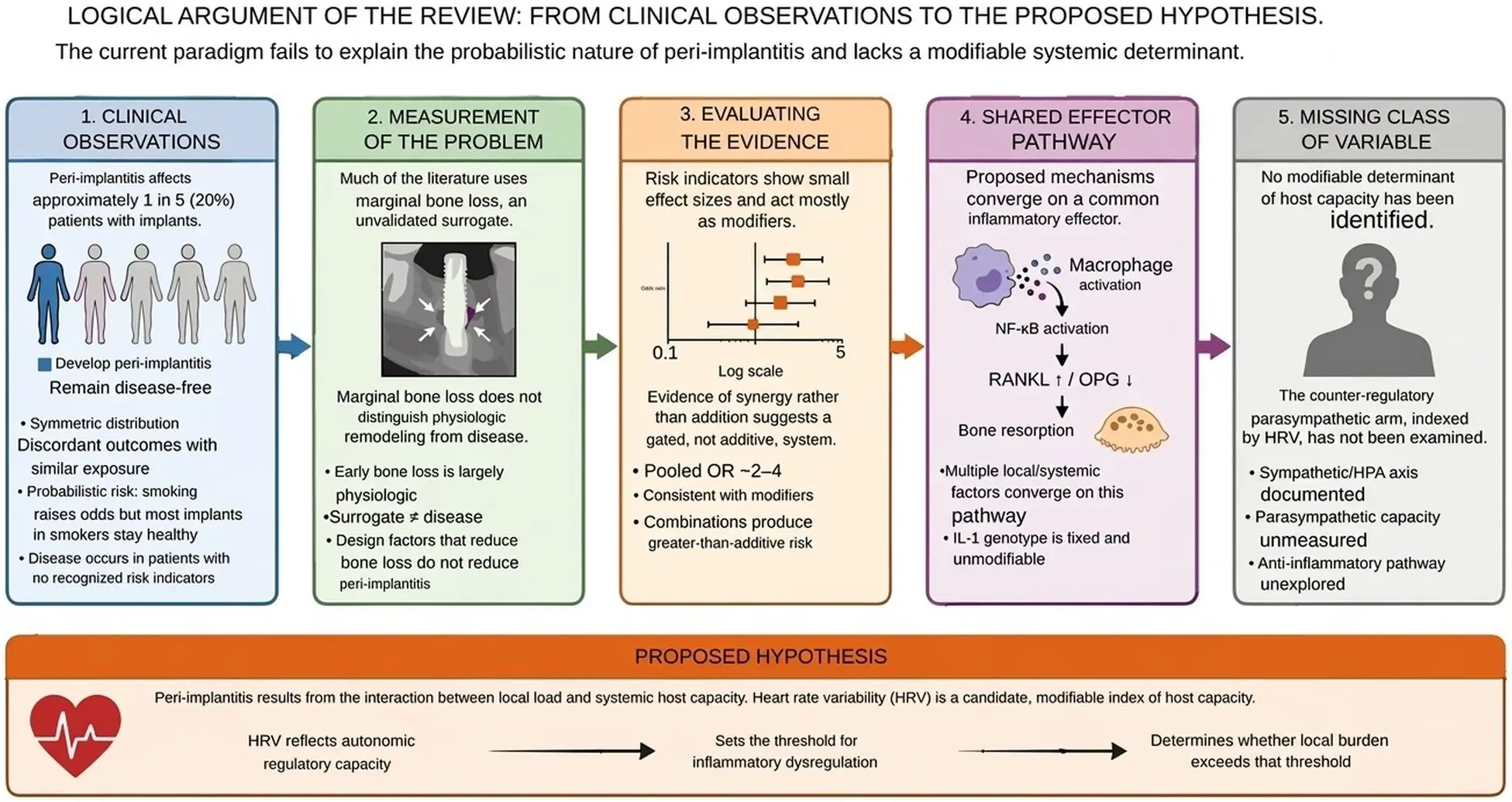
Dentists see patterns that a simple checklist of risks does not explain:
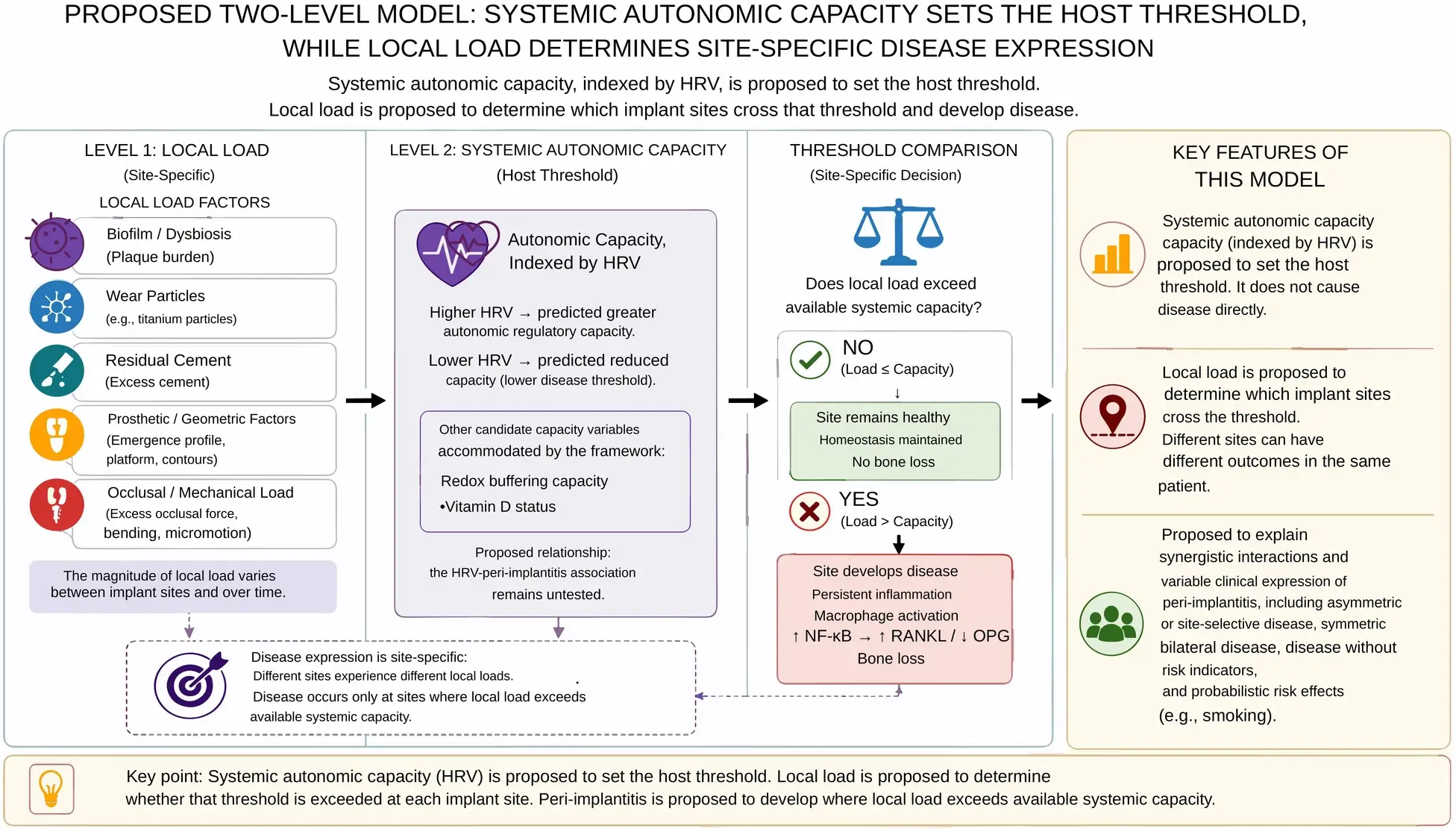
In his paper, Dr. Cheng argues that these patterns point to something missing from the picture. Each implant faces its own local challenge, such as plaque, bite forces or tiny titanium particles. But your body as a whole also has a limited ability to keep inflammation in check. In his model, disease appears at the spot where the local challenge outweighs what your body can contain.
Think of it like a fire brigade. Sparks start at particular spots in the mouth. Whether a spark becomes a fire depends partly on the spark, and partly on how quickly and effectively your body’s brigade responds.
One way to picture the autonomic nervous system is as an accelerator and a brake. The sympathetic response is often associated with activation, while parasympathetic pathways, including the vagus nerve, are involved in regulation and recovery. Research in other fields has explored how these pathways interact with inflammation. Applying that work to peri-implantitis is part of Dr. Cheng’s proposed explanation.
Heart rate variability (HRV) describes variation in the time between heartbeats. Certain HRV measurements can provide information related to autonomic regulation, but readings depend on the method and measurement conditions. HRV can be recorded non-invasively; it is not a direct measurement of inflammation around a dental implant.
Dr. Cheng’s paper proposes that a low HRV may mean a lower threshold for peri-implantitis, so that ordinary plaque and bite forces are more likely to tip into disease. Depression, which is already on the list of risk indicators, is linked with lower HRV, so the two ideas fit together.
What this does not mean. The paper’s literature search identified no direct prospective study testing HRV as a determinant of peri-implantitis. It draws partly on evidence from adjacent fields and sets out studies that could test or challenge the hypothesis. It does not establish that an HRV reading predicts implant failure or determines whether someone should receive an implant.
Clenching and grinding can place repeated mechanical loads on implants. Dr. Cheng proposes that autonomic regulation could be relevant both to inflammatory response and to the activation associated with sleep bruxism. That proposed connection needs testing; it does not mean that every person who grinds has TMD or will develop peri-implantitis.
Three facts make the jaw matter for implants:
Dr. Cheng’s paper suggests that low calming capacity could act on both sides at once: it may lower your threshold for inflammation, and it may raise the bite load through clenching and grinding. This fits earlier research finding that bite overload and plaque bacteria seem to work together rather than separately.
A temporomandibular disorder (TMD) is a group of conditions affecting the jaw joint and chewing muscles. Common signs include:
If you have jaw pain, locking or restricted opening, discuss a TMJ/TMD assessment before or after implant treatment. Clicking without pain is common and does not necessarily need treatment. Our bite correction and malocclusion guide explains the separate assessment of how teeth fit together; a bite change should not be assumed to resolve TMD.
The basics still come first, and one new habit is worth adding: tell your dentist how you use your jaw.
None of this is a reason to avoid implants. They succeed reliably for most people, and for many they are a stable, natural-feeling way to replace a missing tooth. The point is that a good plan looks beyond the empty space.
At a dental implant consultation at Westcoast Smile, we review the missing-tooth area, your gum health, your bite and your records, and decide whether more imaging is needed. We also discuss alternatives such as a bridge or a denture, so the choice fits your situation rather than assuming an implant is always the answer. If an implant is appropriate, you get a written plan that explains the sequence of treatment before you commit.
If you clench, grind or have jaw symptoms, raise them at that first visit. A TMJ/TMD consultation considers your symptoms, jaw function and relevant dental findings. Any additional records or tests should answer a specific clinical question; an HRV reading is not an established test for predicting implant failure.
To book, call (604) 737-1023 or request an appointment. We are at 1–1874 West 1st Avenue, Vancouver, in Kitsilano.
No. It means your plan should account for it, so tell your dentist before treatment starts.
No. Dr. Cheng’s paper is a hypothesis article. It connects existing evidence and sets out predictions that still need to be tested in studies of implant patients.
No validated HRV-based test for predicting peri-implantitis or implant failure is established by this paper. Its proposed relationship still needs direct clinical testing.
Your dentist sets the schedule based on your gums, bite and risk factors. Regular professional maintenance is linked with lower rates of peri-implantitis, so ask what is right for you.
Book a consultation to talk through your goals and options. You can also read our implant guide for Vancouver patients and our article on preventing dental implant complications.
Read the original Frontiers publication, download the full paper PDF, or explore the clinic’s media and publications.
This article summarizes research by our own clinician. Dr. David Cheng works at Westcoast Smile Dental Studio, and the paper below is a hypothesis article, not a clinical trial. It is general information, not personal medical advice.
Request an appointment with Westcoast Smile Dental in Kitsilano, Vancouver.